Quant research, trading, and development: what changes between the roles?
Three ways to work in quantitative finance, and the different questions each role asks every day.
By Sam Zhong
When I started looking more seriously at quantitative finance, I kept seeing three titles together: quant researcher, quant trader, and quant developer. They share a toolkit, but the day-to-day questions are different.
Three roles, one workflow
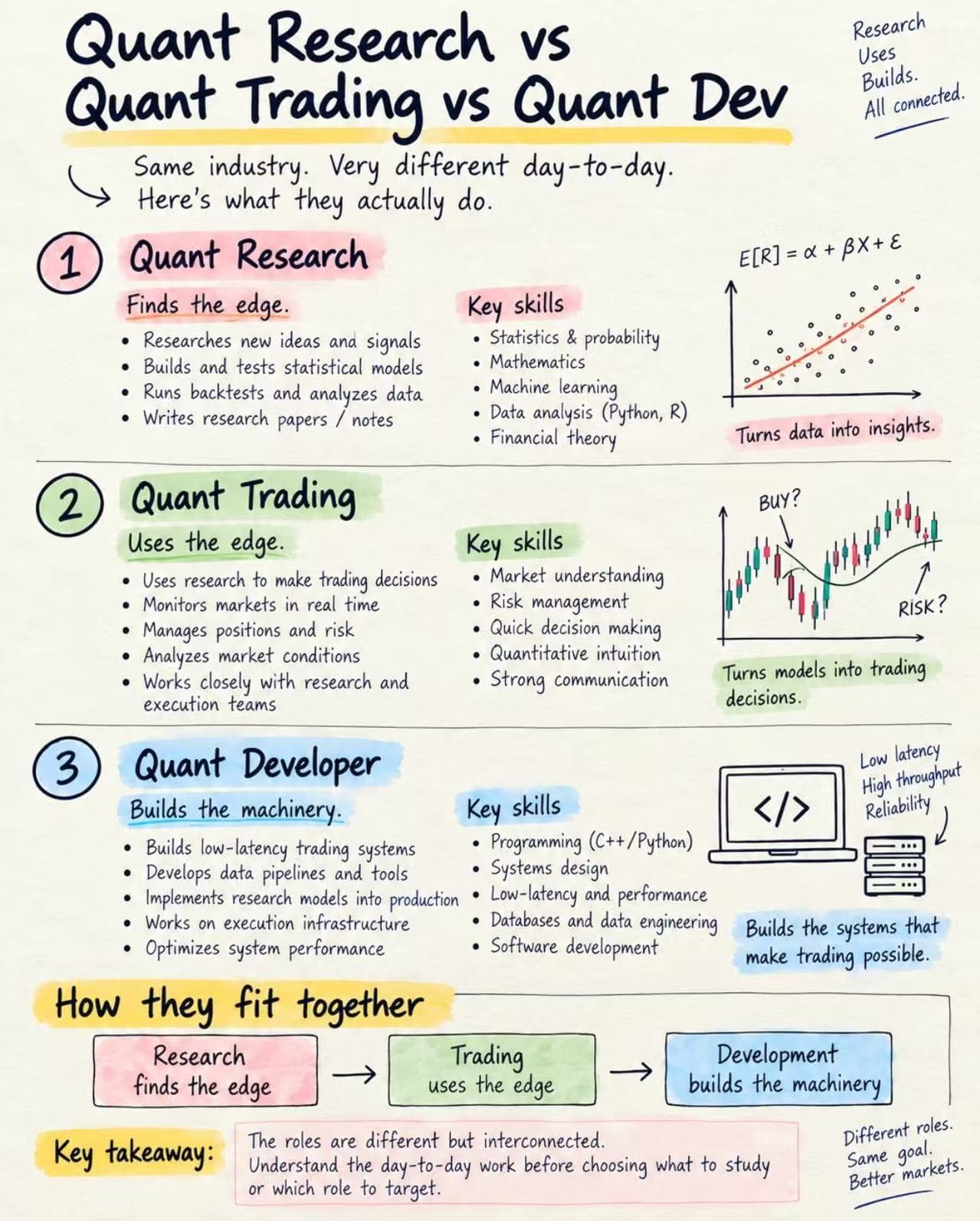
Quant research
Finds the edge
- Main question
- Is this market pattern real and useful?
- Day to day
- Form hypotheses, clean data, build models, and test ideas against historical markets.
- Hard part
- Separate signal from noise, accounting for costs and changing conditions.
- Key skills
- Probability, statistics, mathematics, programming, and healthy skepticism.
Quant trading
Uses the edge
- Main question
- When and how should we act?
- Day to day
- Monitor live markets, positions, liquidity, and risk; turn research into trades.
- Hard part
- Execute sensibly under live conditions while keeping risk under control.
- Key skills
- Market judgment, quick decisions, risk management, and communication.
Quant development
Builds the machinery
- Main question
- Can this idea run reliably in production?
- Day to day
- Build data pipelines, backtesting tools, execution infrastructure, and fast systems.
- Hard part
- Keep data timely and software dependable when performance matters.
- Key skills
- Systems design, data engineering, performance work, and software development.
Quant development feels closest to my computer science background, especially where systems design, data engineering, and performance meet finance.
How they connect
Research looks for an edge, trading decides how to use it, and development makes the whole process work at scale. The boundaries vary by firm, and some people do pieces of all three. Understanding the actual team and its workflow matters more than the title alone.
That overlap is part of what excites me about mathematical finance. In my note on why I chose the University of Toronto's MMF program, I explain why I want to bring my Waterloo CS background into this world.