Two BMO offers, one quant dev decision
What September 16 meant to me, what I remember from the interviews, and how I prepared for behavioral and technical questions.
By Sam Zhong
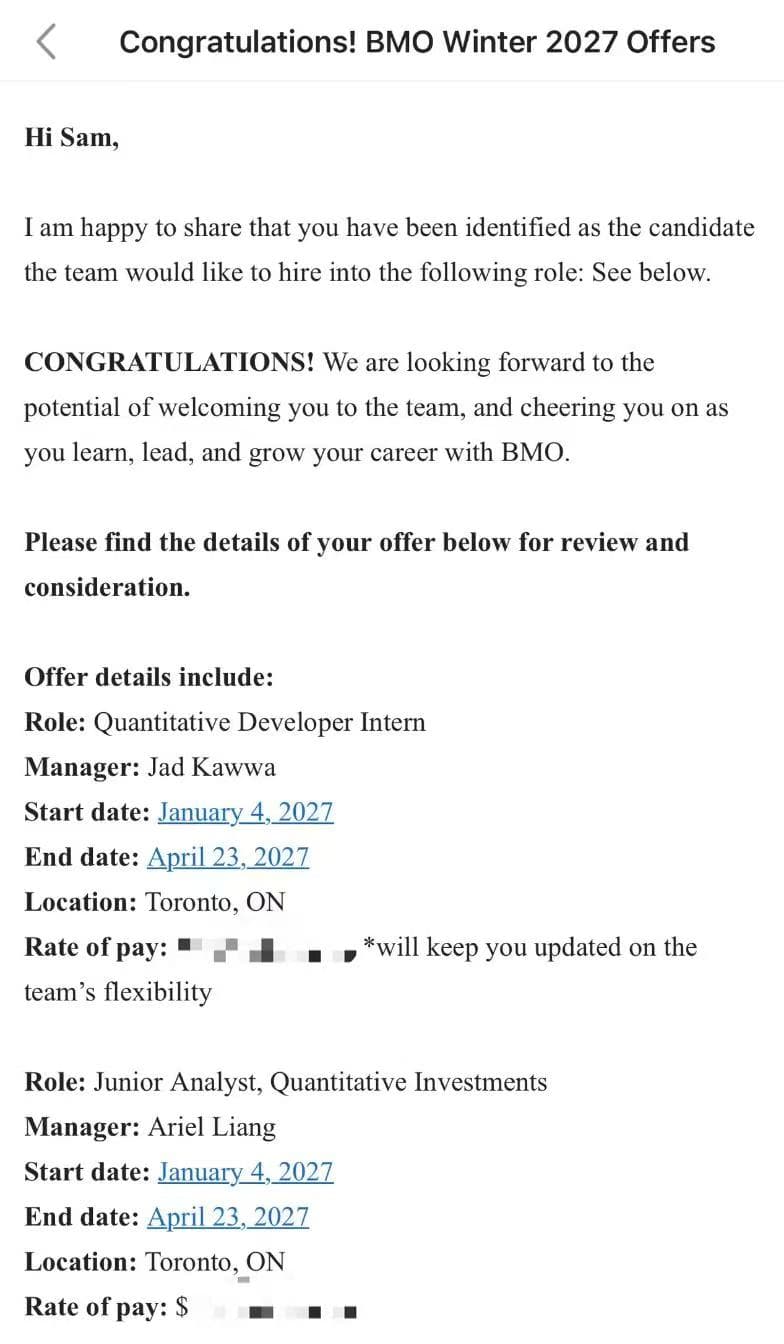
On September 16, 2026, I received two BMO offers on the same day: Quantitative Developer Intern and Junior Analyst, Quantitative Investments. It was one of the most memorable days of my time in the University of Toronto's MMF program.
I was the first person in my class to receive an offer. Later, I learned I was also the first person in the MMF program to receive two offers at once. I felt excited, grateful, and a little stunned. In the end, I chose the quantitative developer position. That was the role I had dreamed about when I moved from Waterloo computer science into mathematical finance.
How I prepared for behavioral questions
My preparation started before BMO. When I interviewed for a software engineering position at Amazon in 2025, I spent a lot of time practicing behavioral questions. I carried that preparation into these interviews and used the STAR structure to keep my answers clear:
- Situation
- Briefly set the scene so the interviewer understands the context.
- Task
- Explain the responsibility or goal that was mine.
- Action
- Spend the most time on the steps I personally took and why I took them.
- Result
- Close with the outcome, a useful metric when I have one, and what I learned.
When a question began with “Tell me about a time when…,” I deliberately shaped my answer around those four parts. I kept the setup short, used “I” to make my own contribution clear, and gave the result enough space to show why the story mattered. The framework helped me stay focused without turning the answer into a memorized speech.
What I remember from the technical interview
I do not remember every question, so this is a record of the topics that stayed with me. On the finance side, I was asked what alpha means and whether a strategy that performs well can be integrated directly into a portfolio. That second question made me think beyond a promising backtest: performance alone does not tell you how a strategy fits with existing positions, risk, or real trading conditions.
The live technical work covered SQL, a Python pandas question, and system design. For SQL, I would be ready to use JOIN, WHERE, GROUP BY, HAVING, and ORDER BY without having to stop and recall the syntax. I cannot reconstruct the exact pandas or system design prompts from memory, so I would rather share the areas than invent the questions.
In person felt different
This was an in-person interview. Before it, most of my interviews had been online, and I expected face-to-face interviewing to be more stressful. For me, it turned out to be less stressful than I imagined. Being able to speak to people directly made the conversation feel more natural. I also know I was lucky, and that another interview day could feel different.
Why I chose quant dev
Both offers meant a lot to me, but quantitative development was the clearest match for the reason I joined MMF: I wanted to bring my software engineering background into finance and build systems that people can actually use. The decision connected my time at Waterloo to the field I am moving into now.
If you are exploring the same path, I wrote more about why I chose mathematical finance and how quant research, trading, and development differ.