Understanding Boosting in Machine Learning: A Comprehensive Guide
How boosting turns a sequence of weak learners into a stronger model, with a look at AdaBoost, gradient boosting, benefits, and real-world uses.
By Sam Zhong
Machine learning models can become more accurate when several simple models work together. Boosting is an ensemble learning method that builds those models in sequence, using what earlier models missed to guide the next step. This guide explains the core idea, the main algorithms, and where boosting is useful.
What is boosting?
A weak learner is a simple model that performs only a little better than a basic baseline. Boosting combines many weak learners into a stronger predictor. Unlike bagging, which trains models largely independently and aggregates them, boosting trains each new learner with information from the learners before it.
The exact information depends on the algorithm. AdaBoost increases the influence of examples that previous learners classified incorrectly. Gradient boosting fits a new learner to reduce the remaining error according to a chosen loss function. In both cases, later learners focus on work the ensemble has not yet done well.
How does boosting work?
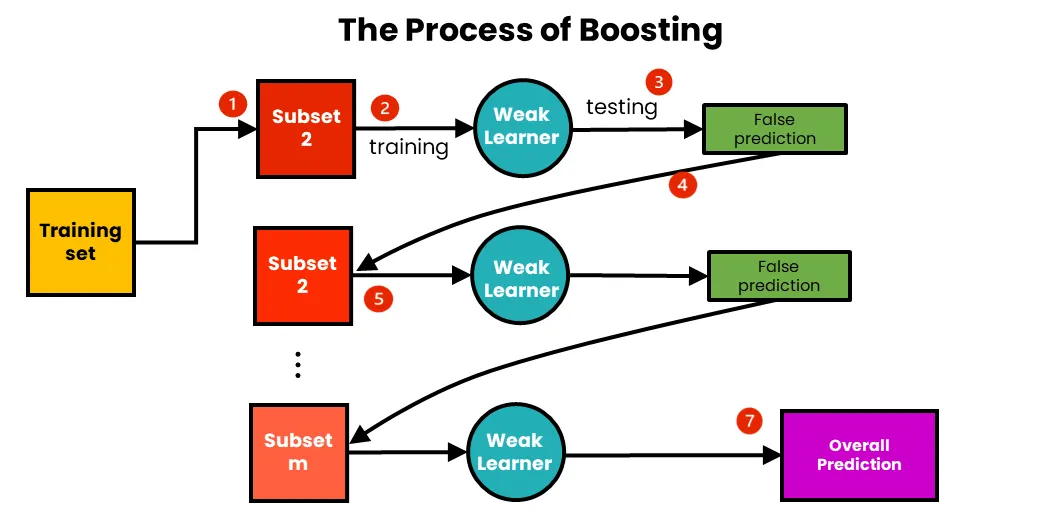
In the common AdaBoost classification example, the process follows these steps:
- Initialize weights. Give each training example equal weight.
- Train a weak learner. Fit a simple classifier, often a shallow decision tree, using the weighted examples.
- Measure its error. Calculate the weighted share of examples it classified incorrectly.
- Update the weights. Increase emphasis on mistakes and decrease emphasis on correctly classified examples.
- Repeat. Train additional learners using the updated weights.
- Combine predictions. Weight the learners according to their performance to make the ensemble's final prediction.
The final model can predict labels for new examples, but good training accuracy alone does not guarantee that it will generalize. Validation on unseen data remains essential.
Common boosting algorithms
AdaBoost (Adaptive Boosting) adjusts example weights after each learner so later learners pay more attention to difficult cases. It is especially associated with classification, though variants can handle regression.
Gradient boosting adds learners that reduce a specified loss function, typically by fitting the loss's negative gradient. It supports classification and regression. XGBoost and LightGBM are popular optimized implementations of gradient-boosted trees.
Stochastic gradient boosting trains each new learner on a random sample of rows. Some implementations also sample features. This randomness can help limit overfitting, depending on the data and settings.
LPBoost formulates boosting as a linear programming problem that seeks a large classification margin. TotalBoost is another margin-oriented boosting method that uses a total corrective update. They are less common in applied work than AdaBoost and gradient-boosted trees.
Choosing among these methods depends on the task, dataset, loss function, training cost, and how well a model performs on held-out data.
Advantages and trade-offs
Boosting often delivers strong predictive performance because successive learners can capture patterns that a single simple model misses. Tree-based boosting handles non-linear relationships and feature interactions, and its loss functions and base learners can be adapted to different tasks. Feature importance measures can offer clues about model behavior, though they do not fully explain any individual prediction.
The method also needs care. A flexible boosted model can overfit if it grows too large or runs for too many rounds. AdaBoost's focus on misclassified examples can make it sensitive to mislabeled data and outliers, so boosting should not be assumed to be robust to noise. Use validation data, sensible regularization, and appropriate evaluation metrics when tuning it.
Where is boosting used?
Boosted models appear in image and object recognition, text classification, fraud detection, medical risk prediction, recommendation systems, and time series forecasting. In each setting, they learn from labeled examples to improve a specific prediction task. The choice of features and evaluation design matters as much as the algorithm: for example, time series data must be split chronologically to avoid learning from the future.
Boosting is particularly useful when a strong tabular-data baseline is needed. It provides a practical way to turn many modest learners into one capable model, as long as its gains hold up on data it has not seen.